
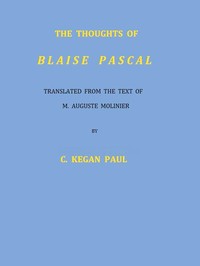
The Thoughts of Blaise Pascal by Blaise Pascal
Let's be clear from the start: this is not a novel. 'The Thoughts of Pascal' (or Pensées) is a collection of fragments—ideas, arguments, and brilliant observations that Pascal jotted down for a book he never finished. He was a scientific genius (he helped invent the calculator!) who had a profound religious experience. He wanted to write a persuasive case for Christian faith, aimed at skeptical, intelligent people like his friends. What we get instead are his working notes, organized by later editors. It jumps from logic to emotion, from math proofs to cries of the heart.
The Story
There's no plot in the usual sense. The 'story' is the journey of Pascal's mind as he tries to make sense of human life. He starts by painting a picture of our misery and greatness. We build empires and write poetry, but we're also deeply bored, vain, and terrified of being alone with our thoughts. He famously calls us 'thinking reeds'—incredibly fragile, yet superior to the entire universe because we can understand it. The core of his argument is what's now called 'Pascal's Wager.' He says we're all gambling with our lives. Since we can't prove God exists or doesn't, we have to choose how to live. He asks: isn't it wiser to bet on faith? If you're right, you gain everything. If you're wrong, you've still lived a hopeful, meaningful life.
Why You Should Read It
You should read this because Pascal gets you. I mean, he really does. Reading his thoughts on our addiction to distraction—'chasing a ball or a hare'—feels like he's describing our scroll through social media. His insights into pride and self-deception are uncomfortably accurate. This isn't dry theology; it's a psychological masterpiece. He doesn't shame you into belief. He starts from a place of shared confusion and wonder. The writing is intense and poetic in places. You'll find lines that stop you cold and make you stare at the wall for a minute.
Final Verdict
This book is perfect for the thoughtful reader who likes big questions. If you enjoy philosophy, psychology, or just understanding why people (including yourself) act the way they do, you'll find gold here. It's also great for anyone interested in the history of ideas. Be warned: it's fragmented and can be tough going in spots. Don't try to read it straight through. Dip in, read a few thoughts, and let them simmer. It's not a quick read, but it's a companion for life. Approach it not as homework, but as a conversation with one of history's most restless and brilliant minds.
You are viewing a work that belongs to the global public domain. Access is open to everyone around the world.
Charles Hill
3 months agoUsed this for my thesis, incredibly useful.
Lucas Harris
2 years agoI was skeptical at first, but it manages to explain difficult concepts in plain English. A valuable addition to my collection.
Kimberly Smith
4 months agoI was skeptical at first, but it provides a comprehensive overview perfect for everyone. I couldn't put it down.
Kimberly King
6 months agoWithout a doubt, the clarity of the writing makes this accessible. Worth every second.


Joseph Scott
2 years agoGreat reference material for my coursework.