
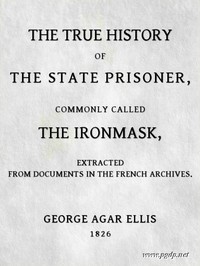
The True History of the State Prisoner, commonly called the Iron Mask by Dover
Ever since I was a kid, the story of the Man in the Iron Mask has fascinated me. You know the one—the mysterious prisoner during the reign of France’s Sun King, Louis XIV, who was forced to wear a mask and whose identity was a state secret. This book isn't a novel, though. It's a historical investigation written in the 1820s by George Agar Ellis. He wasn't just re-telling a legend; he was trying to get to the bottom of it using the documents available at the time.
The Story
There isn't a traditional plot here. Instead, the book follows the trail of evidence. Ellis starts with the known facts: a prisoner was held for decades in French fortresses like Pignerol and the Bastille, under the direct orders of the king. His face was concealed, but not necessarily by an iron mask—more likely a velvet one. Ellis then sifts through the theories that had swirled for over a century. Was he a disgraced minister? A illegitimate royal sibling? The author compares these rumors to the actual prison registers and correspondence from the king’s officials. He acts like a historical detective, separating the probable from the purely sensational. The 'story' is the slow, methodical process of trying to unmask a ghost from the archives.
Why You Should Read It
I loved this because it shows how history works. A single, strange event gets blown up into a massive legend. Ellis doesn't give us a neat, Hollywood answer. Instead, he shows us the messiness of the past. You get a real sense of the absolute power of Louis XIV—one man could simply make another disappear forever on a whim. The most compelling part is following Ellis's logic. He builds his case, points out where the popular stories fall apart, and presents what he thinks is the most likely identity of the prisoner. Reading it, you feel like you're right there with him, dusting off old papers and trying to solve a centuries-old mystery.
Final Verdict
This is perfect for history buffs who enjoy true crime or unsolved mysteries from a different era. It’s also great for anyone who knows the fictional versions from books and movies and wants to see the real historical groundwork. Be warned: it’s a 19th-century history book, so the language can be a bit formal at times. But if you have the patience, it’s a rewarding look at one of history’s greatest enigmas, written by someone who was just as captivated by it as we are.
No rights are reserved for this publication. Feel free to use it for personal or commercial purposes.
Steven Wright
1 year agoIf you enjoy this genre, the clarity of the writing makes this accessible. Highly recommended.
Robert Lewis
1 year agoA bit long but worth it.
Matthew Robinson
2 years agoHaving read this twice, it creates a vivid world that you simply do not want to leave. I couldn't put it down.






John Thompson
9 months agoI decided to give this a try based on a colleague's recommendation, the way it challenges the status quo is both daring and well-supported. The insights gained here are worth every minute of reading.