
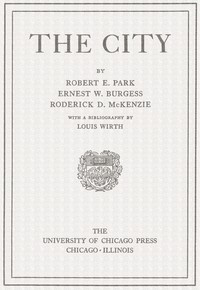
The city by Robert Ezra Park, E. W. Burgess, and Roderick Duncan McKenzie
Let's be clear: this isn't a novel with a plot. There's no main character named Joe navigating the mean streets. Instead, the 'story' here is the city itself—its birth, its growth, and its internal logic. The book is a collection of essays where Park, Burgess, and McKenzie lay out their groundbreaking observations from studying Chicago in the early 20th century.
The Story
Think of it as the origin story for urban sociology. The authors argued that a city isn't just a random pile of people and buildings. It grows in patterns, almost like a living organism. Burgess famously proposed the 'concentric zone model,' imagining the city as a set of rings expanding from the busy downtown core out to the quiet suburbs. They explored how different immigrant groups would settle in specific 'natural areas,' creating distinct cultural pockets. The 'conflict' in the book is the constant tension between these different zones and groups as the city evolves, competes for space, and changes its identity over time.
Why You Should Read It
What's amazing is how relevant this 100-year-old book still feels. When you read about the 'zone of transition'—the run-down areas just outside the downtown core—you're reading a perfect description of neighborhoods that later become targets for gentrification. Their ideas give you a lens to understand why your city has a 'nightlife district,' an 'industrial park,' or why certain communities are clustered together. It turns your daily commute into a lesson in human ecology. You start seeing the history and social forces etched into the layout of the streets.
Final Verdict
This is a must-read for anyone who loves cities, urban planning, or sociology. It's perfect for the curious person who walks around their town and wonders, 'Why is it like this?' It's also great for readers of popular science or history who enjoy seeing how a big, foundational idea was first presented. While it's an academic work at heart, the writing is clear and the concepts are powerful. Don't expect a light beach read, but do expect to have your perspective on every city you ever visit permanently changed.
This digital edition is based on a public domain text. It is available for public use and education.
Richard Smith
8 months agoUnlike many other resources I've purchased before, the clarity of the writing makes even the most dense sections readable. I'll be recommending this to my students and colleagues alike.
Christopher White
6 months agoI found the author's tone to be very professional yet accessible, the author clearly has a deep mastery of the subject matter. An excellent example of how quality digital books should be formatted.
George Lopez
1 year agoThe clarity of the introduction set high expectations, and the argument presented in the middle section is particularly compelling. This has become my go-to guide for this specific topic.
George Jackson
1 month agoI found the data interpretation to be highly professional and unbiased.


Christopher Miller
1 year agoClear, concise, and incredibly informative.