
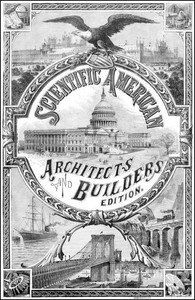
Scientific American Architects and Builders Edition, No. 26, Dec., 1887 by Various
Let's be clear: this isn't a book with characters and a three-act structure. This is a professional trade magazine from 1887, a monthly digest of the latest knowledge for the people designing and constructing America's rapidly growing cities. Think of it as the 19th-century equivalent of an industry blog or a technical forum, printed on thick, musty paper.
The Story
The 'story' is the collective effort to build the future. Each article and illustration tackles a specific challenge. One piece might detail the proper ventilation system for a new hospital, complete with intricate diagrams of ductwork. Another argues for the use of a novel 'fireproof' flooring material. You'll find discussions on the acoustics of auditoriums, the best practices for laying intricate parquet floors, and spec sheets for the latest steam-powered heating boilers. Advertisements show off new tools, fancy door hardware, and brands of Portland cement. The through-line is a palpable sense of momentum—a profession sharing breakthroughs to build bigger, safer, and more impressive structures.
Why You Should Read It
I love this because it strips away the romance and shows the brass-tacks reality of making history. We see the Statue of Liberty or a beautiful old train station as monuments. This magazine shows the plumbing, the rivets, and the math behind them. The authors write with a mix of pride and practicality that's completely absorbing. You get a real sense of their personalities: some are cautious traditionalists, while others are evangelists for newfangled ideas like electric lighting. It makes you appreciate every old building you walk past in a whole new way. You start to see the hidden skeleton, the solved problems in every cornice and column.
Final Verdict
This is a niche read, but a deeply rewarding one. It's perfect for history buffs who want more than dates and names, for architecture fans curious about the 'how,' and for anyone with a DIY or engineering mindset who enjoys old technical manuals. It's not a page-turner in the traditional sense, but it is a captivating portal. You don't read it cover-to-cover; you dip in and out, marveling at the ingenuity on display. If the thought of reading a detailed 1887 article on roof truss design makes you smile, this is your holy grail.
This book is widely considered to be in the public domain. It is now common property for all to enjoy.
Liam Johnson
1 year agoI didn't expect much, but the pacing is just right, keeping you engaged. Exactly what I needed.
Mary Smith
1 year agoFive stars!
Christopher Young
1 year agoSurprisingly enough, the arguments are well-supported by credible references. Don't hesitate to start reading.






Mason Taylor
2 months agoThis book was worth my time since the clarity of the writing makes this accessible. Highly recommended.