
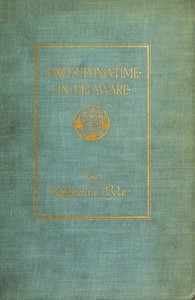
Once Upon a Time in Delaware by Katharine Pyle
Katharine Pyle's Once Upon a Time in Delaware takes us back to the 1600s, when the land along the Delaware River was a prize fought over by European powers. But Pyle smartly keeps the focus tight on the ground, on the settlers who came to build new lives.
The Story
The book follows the founding and fragile early years of the colony. We see the hopeful arrival of Swedish families, their struggles to establish farms and a fort (Fort Christina, in what's now Wilmington). Their peace is short-lived. Soon, Dutch ships arrive from New Amsterdam, eyeing the same territory. The settlers find themselves caught in a quiet, tense struggle for control, where a change of flag at the fort could happen with little warning, reshaping their lives overnight. Later, English ambitions add a third layer of pressure. Through it all, the narrative follows how these communities—Swedish, Dutch, Finnish, and eventually English—learned to live alongside each other, negotiate, and slowly blend into something new, even as their homelands across the ocean argued over who owned the dirt under their feet.
Why You Should Read It
Pyle has a gift for making history feel immediate. She doesn't just tell us there was conflict; she shows us how it might have felt to see an unfamiliar ship sail up the river, not knowing if it meant new neighbors or a new governor. The real strength here is her focus on the domestic and community scale. We get a sense of the log cabins, the trade for beaver pelts, the challenges of frontier life that were constant, no matter whose flag flew. It’s a story about adaptation. These weren't just pawns in an imperial game; they were people planting gardens, building churches, and making homes in a world of shifting loyalties. Pyle reminds us that history is made as much around kitchen tables and in village meetings as in royal courts.
Final Verdict
Perfect for readers who enjoy American history from the ground up, not the top down. If you liked the frontier feel of books like Laura Ingalls Wilder's but want an earlier, less-known setting, this is a fascinating dive. It's also great for anyone from Delaware or the Mid-Atlantic region curious about the deep roots of their home. Pyle's writing is clear and engaging, free of academic jargon, making it a very accessible and human-centered look at a pivotal, often-overlooked chapter in America's story. You'll finish it seeing the quiet courage in building a life when the very ground you stand on is disputed.
This is a copyright-free edition. Thank you for supporting open literature.
Michael Lee
5 months agoFinally found a version that is easy on the eyes.
Ashley Miller
2 years agoThe peer-reviewed feel of this content gives me great confidence.
Patricia Jackson
8 months agoIt’s rare to find such a well-structured narrative nowadays, the formatting on mobile devices is surprisingly crisp and clear. It’s hard to find this much value in a single source these days.
Joseph Davis
3 months agoI particularly value the technical accuracy maintained throughout.








Jessica White
5 months agoThe research depth is palpable from the very first chapter.